Using policy and legal reform to reduce violence against women at scale.
Many proven violence prevention strategies tend to be small-scale and depend on intensive community or group work. But governments—the usual partners for scaling social interventions—typically have neither the workforce nor the community trust to drive such efforts. Policies for Prevention is a joint initiative between the Prevention Collaborative and the World Bank Africa Gender Innovation Lab that takes a different approach. We seek to identify evidence‑informed policy and legal reforms that governments can adopt to reduce intimate partner violence and sexual assault at scale, playing to governments’ core strengths while responding to feminist calls for structural change.
The generation of evidence on policy reform and violence reduction has been largely shaped by individual research interests rather than a strategic assessment of where the greatest potential lies. We are addressing this by co-developing a research agenda that guides investigators toward the most important and viable policy options, and by growing a network of researchers to advance it.
“Achieving reductions in prevalence, at scale, by definition, means going beyond small-scale interventions. It really calls for very strong government action across sectors, grounded in policy and legal reform, to shift incentives and systems towards prevention, and not just response.”
Even where evidence exists, the potential of policy reform outside of justice systems, such as education, alcohol regulation, and family law, is not yet on the radar of most policymakers, their advisors, or violence prevention advocates as related to VAWG. A critical part of our work is changing that. This project will catalyse policy dialogues that bring together governments, UN agencies, multilateral institutions, funders, and civil society to explore the evidence, discuss what is feasible, and prepare the ground for policy experimentation and implementation. Many of these actors are well placed to support pilot programmes, fund research, and create the political conditions in which policy reform becomes possible. Strengthening their understanding of and engagement in prevention strategies is a prerequisite for change at scale.
Women’s rights organisations play a key role in advocating for and holding governments accountable for their national and international commitments. Many WRO efforts related to violence to date have been focused on strengthening services and reforming laws that directly address domestic violence, rape, and child marriage. Evidence increasingly shows that reforms in areas like labour policy, social protection, alcohol regulation, and family law can effectively reduce violence as well. We will work to make these findings widely available to civil society and women’s rights organisations and explore how policy reform in areas beyond violence-specific laws could offer new targets for advocacy for those seeking to address the structural causes of VAW.
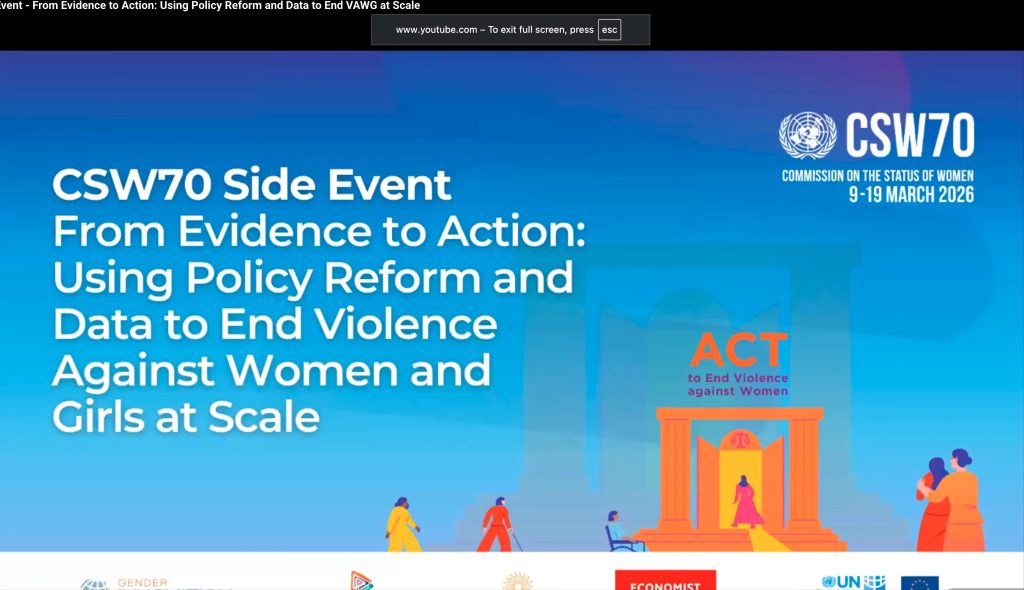
From Evidence to Action: Using Policy Reform and Data to End Violence Against Women and Girls at Scale